
Theoretical Foundations, Architecture, PHP Kernel, and Web Application Management
1. Introduction
The evolution of the Internet has fundamentally transformed the way software applications are designed, developed, and used. Modern web platforms are no longer limited to displaying information. They have evolved into complex environments for application execution and digital service management.
The need for unified management of applications, users, permissions, services, data, and resources has led to architectural approaches that, in several respects, resemble the operation of traditional operating systems.
Within this context, the concepts of WebOS (Web Operating System) and Web Kernel emerge. A WebOS provides an integrated operating environment through the web, while the Web Kernel acts as the central mechanism responsible for organizing and coordinating its operations.
When such a kernel is implemented using PHP, it can be referred to as a PHP Web Kernel or PHP Kernel.
2. Definition and Theoretical Framework of a WebOS
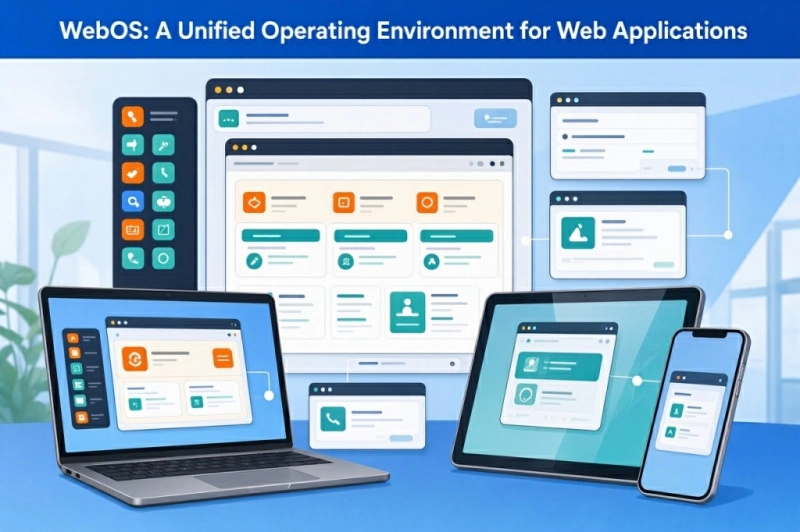
The term WebOS (Web Operating System) describes a web-based software environment that provides unified access to applications, services, data, and functionality through a Web Browser.
Unlike a traditional operating system, a WebOS does not necessarily manage the computer's hardware directly. Instead, it operates as a higher-level software layer, leveraging the capabilities of the server's operating system and infrastructure.
A WebOS may provide functionality such as user management, application execution, file storage, notifications, communication, task management, and a centralized user interface.
2.1. Fundamental Characteristics
2.2. WebOS and Traditional Operating Systems
Although WebOS platforms use terminology derived from operating systems, they should not be considered equivalent to general-purpose operating systems such as Linux or Windows. The similarity primarily concerns the organization and management of applications and services within a unified environment.
3. What Is a Web Kernel?
A Kernel is the core component of a software system. In traditional operating systems, it is responsible for fundamental operations such as process management, memory management, device interaction, and access control.
In a WebOS, the Web Kernel assumes a different but architecturally related role: it acts as the central coordinator of the platform's web applications and services.
It does not directly manage hardware or replace the underlying operating system kernel of the server. Instead, it manages the application execution environment belonging to the WebOS.
3.1. Core Responsibilities
3.2. The Web Kernel as an Application Orchestrator
A modern architectural approach is to treat the Web Kernel as an Application Orchestrator. In this model, the kernel does not necessarily contain the business logic of every application. Instead, it coordinates their execution and provides the services they require.
This approach establishes a clear separation between the central operational mechanism and the applications running on top of it.
4. The PHP Web Kernel
A PHP Web Kernel is a centralized mechanism for managing web applications, implemented using the PHP programming language. It leverages PHP capabilities for processing HTTP requests, managing data, communicating with databases, and providing shared services.
PHP offers a mature ecosystem of libraries and tools that supports the development of modular and extensible architectures. A PHP Kernel can therefore serve as the foundation of an integrated WebOS platform.
4.1. Core Building Blocks
4.2. PHP Kernel vs. PHP Framework
A PHP Kernel is not necessarily equivalent to a PHP Framework. A framework provides a collection of tools, libraries, and conventions for application development. A Web Kernel, on the other hand, serves as the central operational mechanism of a platform.
A WebOS may use an existing framework as an internal development tool, but it may also implement its own Kernel and independent Application Runtime.
5. WebOS Architecture
A WebOS architecture is typically organized into distinct layers that cooperate to provide a unified operating environment.
5.1. Illustrative Architecture
Web Browser / User Interface
Apache / Nginx / HTTP Server
Bootstrap · Router · Security · Runtime · Services
Database / Cache / Filesystem / External Services
5.2. Presentation Layer
The Presentation Layer is the point of interaction between the user and the WebOS. It includes the user interface, menus, applications, and interface components.
5.3. Kernel Layer
The Kernel Layer contains the central operational mechanisms, including routing, security, service management, and the application execution lifecycle.
5.4. Application Layer
The Application Layer contains the individual functional units of the WebOS. Each application may have its own business logic, data, routes, and user interface, while following the shared specifications established by the Kernel.
5.5. Infrastructure Layer
The Infrastructure Layer includes databases, the filesystem, caching mechanisms, network services, and external integrations.
6. Request Lifecycle and Kernel Execution
The Request Lifecycle describes the sequence of stages followed from the moment a user submits a request until the final response is delivered.
6.1. Main Execution Stages
- The user submits an HTTP Request.
- The Web Server receives the request.
- The WebOS entry point is executed.
- The Kernel initializes the operating environment.
- Required security checks are performed.
- The Router identifies the target application and operation.
- The Application Loader loads the required components.
- The Application Runtime executes the application.
- The HTTP Response is generated.
- The response is returned to the user.
6.2. Separating Kernel and Application Execution
The Kernel should not be responsible for implementing the entire business logic of individual applications. Its role is to establish the appropriate execution environment and ensure that applications operate according to the platform's rules.
This separation simplifies development and maintenance while allowing applications to evolve independently.
7. Kernel Subsystems
A complete PHP Web Kernel may consist of several independent but cooperating subsystems.
7.1. Bootstrap and Initialization
Bootstrap is the initial stage of system operation. It loads core configuration, required libraries, and essential services, preparing the environment for Kernel execution.
7.2. Routing System
The Routing System maps each incoming request to a specific application, service, or operation. It is one of the most important mechanisms connecting the external environment with the WebOS.
7.3. Service Container
The Service Container manages shared system services and makes them available to the components that need them. These services may include logging, database access, caching, and configuration management.
7.4. Event Dispatcher
The Event Dispatcher enables subsystems to communicate through events without requiring direct dependencies between them. This architecture promotes extensibility and loose coupling.
7.5. Middleware Pipeline
Middleware components form sequential processing stages for incoming requests. They can be used for authentication, authorization, logging, validation, and other processing requirements.
7.6. Configuration Management
Configuration Management provides centralized configuration for the system, its applications, and its services. Settings can be organized according to different environments, such as development, testing, and production.
7.7. Error and Exception Management
The Kernel provides consistent error and exception handling. It offers mechanisms for logging, reporting, and controlled error presentation, without exposing sensitive information to end users.
8. Application Management and Runtime
One of the most important characteristics of a WebOS is its ability to manage multiple applications within a unified operating environment.
8.1. Application Management
Application Management includes application registration, discovery, loading, activation, and lifecycle management.
Each application may define metadata, version information, requirements, dependencies, and compatibility declarations for the Kernel.
8.2. Application Runtime
The Application Runtime is the environment in which an application executes. It provides the services and operational context required for its proper execution.
In a PHP WebOS, the Runtime may rely on the PHP execution engine while introducing an additional management, control, and isolation layer.
8.3. Modular Architecture
A modular architecture allows a WebOS to be built from independent subsystems. Each module can introduce new capabilities without requiring modifications to the core Kernel.
8.4. Application Lifecycle
An application's lifecycle may include registration, discovery, initialization, activation, execution, deactivation, and removal. These stages should be defined through a clear operational contract between the application and the Kernel.
9. Security and Resource Management
Security is a fundamental requirement for every WebOS, since multiple applications and services share the same infrastructure and central mechanisms.
9.1. Authentication and Authorization
Authentication verifies the identity of a user, while authorization determines which operations that user is permitted to perform. These two functions should be architecturally separated.
9.2. Application Isolation
Applications should operate within clearly defined access boundaries. Access to the data, services, and functionality of other applications should only occur through controlled interfaces.
9.3. Resource Management
The Kernel may enforce resource management policies, such as execution time limits, request size restrictions, access constraints, and mechanisms that protect against excessive resource consumption.
9.4. Audit Logging
Recording critical operations makes it possible to monitor system activity and investigate security incidents. Logging must follow policies that protect personal and sensitive information.
10. Comparative Analysis of Architectures
A Web Kernel can be designed using different architectural models, depending on the platform's requirements.
10.1. Monolithic Kernel
In this model, most Kernel functionality is concentrated in a single system. This approach offers a simpler initial implementation but may make maintenance more difficult as complexity increases.
10.2. Modular Kernel
A Modular Kernel is organized into distinct modules, each with specific responsibilities. These modules cooperate through clearly defined interfaces.
10.3. Microkernel-inspired Architecture
This approach keeps only essential functionality within the core Kernel and moves additional capabilities into independent services or modules. It draws architectural inspiration from microkernel operating systems, but does not necessarily constitute a true operating-system microkernel.
10.4. Comparative Table
| Architecture | Advantages | Disadvantages | Suitability |
|---|---|---|---|
| Monolithic | Simplicity, direct communication | High internal coupling | Small systems |
| Modular | Extensibility, clear organization | Requires interface management | Medium and large WebOS platforms |
| Microkernel-inspired | Separation of concerns, isolation | Greater complexity | Complex platforms |
11. An Illustrative PHP Kernel Implementation
The following simplified implementation demonstrates the basic concept of a PHP Kernel. It is not a complete WebOS, but rather an illustrative example of how a central execution mechanism can be organized.
11.1. Basic Kernel Class
<?php

declare(strict_types=1);

namespace WebOS\Core;

final class Kernel
{
    private bool $booted = false;

    public function __construct(
        private readonly Router $router,
        private readonly ApplicationManager $applications
    ) {
    }

    public function boot(): void
    {
        if ($this->booted) {
            return;
        }

        $this->initialize();
        $this->booted = true;
    }

    private function initialize(): void
    {
        // Initialize system services.
        // Load configuration.
        // Register application definitions.
    }

    public function handle(Request $request): Response
    {
        $this->boot();

        $route = $this->router->match($request);

        return $this->applications->execute(
            $route,
            $request
        );
    }
}
The Kernel class acts as the central coordination point. It does not implement individual applications but cooperates with the Router and ApplicationManager to manage their execution.
11.2. Core Design Principles
12. The Evolution of WebOS Platforms
The evolution of WebOS platforms is closely connected to the transition from simple web applications to integrated digital service environments.
The adoption of APIs, distributed services, cloud infrastructure, and artificial intelligence creates new opportunities for organizing and executing applications within a common environment.
12.1. API-first WebOS
An API-first approach allows the Kernel to expose its services through well-defined interfaces, facilitating integration with external applications and systems.
12.2. Cloud-native WebOS
Cloud infrastructure enables the development of systems with increased availability, scalability, and the ability to distribute functionality across different infrastructure environments.
12.3. AI-assisted WebOS
Artificial intelligence integration can provide intelligent search, task automation, data analysis, and adaptive user environments.
In this architecture, artificial intelligence operates as an additional service layer rather than an uncontrolled execution mechanism. Critical operations remain subject to the Kernel's security and authorization policies.
13. Conclusions
A WebOS is an integrated web-based operating environment, while the Web Kernel is the central mechanism that coordinates its applications and services.
Implementing a PHP Web Kernel makes it possible to build modular, extensible, and well-organized platforms capable of supporting multiple applications within a shared operating environment.
The real value of such a system does not simply lie in centralizing code, but in establishing clear architectural rules, shared services, and controlled execution mechanisms.
A properly designed Web Kernel can therefore serve as the foundation of an entire ecosystem of applications, services, and digital operations.
14. The AlexSoft Approach
AlexSoft Software approaches the development of complex web platforms through the principles of a centralized core, modular architecture, and separation of functional layers.
This philosophy enables the creation of systems in which applications are not isolated software units, but components of a unified and organized ecosystem.
The WebOS and PHP Web Kernel architecture represents an important design approach for developing such platforms, providing the foundation for shared services, application management, extensibility, and centralized operational control.
15. Bibliography
- Tanenbaum, A. S. & Bos, H. - Modern Operating Systems. Pearson.
- Silberschatz, A., Galvin, P. B. & Gagne, G. - Operating System Concepts. Wiley.
- PHP Documentation - Official PHP Documentation .
- W3C - Technical Reports and Web Standards .
- RFC 9110 - HTTP Semantics .
- PSR Standards - PHP Framework Interop Group .
- Fowler, M. - Patterns of Enterprise Application Architecture. Addison-Wesley.
- Gamma, E. et al. - Design Patterns: Elements of Reusable Object-Oriented Software. Addison-Wesley.